
MSP marketing (and Sales), the essential Guide
So, you have an MSP. You’ve set up RMM and your PSA and created your product and product stack.
Now, all you need is customers.
What is MSP marketing? It is the tools and process by which you turn strangers into customers and customers into raving fans. It is a defined, structured process that mimics dating. If you don’t follow the process, you will waste your money, so start with simplicity and build from there.
MSPs tell us that their most pressing concern is customer acquisition. It keeps many MSP owners up at night, and not having a predictable sales funnel (or an MSP marketing process) is the most crucial reason MSPs stay small. This is true even though the MSP market is growing steadily and quickly.
Most MSP owners understand that MSP Sales and Marketing require effort and investment. So, you may already be dedicating effort and spending thousands of dollars a month.
The problem is that, based on our experience with MSPs, you are likely wasting your money, time, and effort. In this post, I go through the fundamentals of MSP marketing so that you know what to look for and what you need. In our experience, most MSPs are marketing an agnostic product to an agnostic business, which is extremely expensive.
I know that most people who first come to this guide will want marketing ideas you can implement now. So here are 5 MSP marketing ideas you can implement now that are consistent with the rest of this guide
The one who pays the most within a given market gets the customer.
There are roughly 33 million businesses in the US, employing 61 million people. All these businesses are very busy trying to make all other businesses aware of their existence so that they can sell stuff. As a result, the average person in the US sees 10,000 marketing messages daily.
Because of this, the company that gets its message out the most and the most prominently wins. This means that all else equal, the one who spends the most wins the customer.
I’m willing to bet you can’t spend the most. Many marketers would like to convince you to try, but you can’t, so don’t. (Mr. Gates and Mr. Buffett, thanks for reading, but you can actually buy your way to success.)
That means that if you are a small MSP trying to market to everyone, there’s a good chance that someone else will pay more. This makes the customer acquisition cost astronomical.
This means you can spend tens of thousands of dollars (or the equivalent in time) to acquire one client. I’ve looked at several MSP marketing programs that “weren’t working” because they’d spent “so much money” and gotten few clients.
There are many reasons why marketing fails, but we don’t fix these things because the cost of fixing them feels too high. Instead, we spend as little as we think we can get away with and hope we get a good result.
Hope is a lousy strategy.
(Alternatively, we work like crazy and believe that hard work with a weak strategy will pay off; it doesn’t).
The best way to reduce your acquisition cost is to create an unassailable competitive advantage through focus and getting to know your ideal customer.
If you need to water down your story to appeal to everyone, it will appeal to no one.
Seth Godin
Before we talk about how to market better, we have to start by defining marketing. I’ll start with what marketing isn’t, then move on to what marketing is.
What marketing isn’t
We typically think of marketing as ads, social media posting, and getting the word out.
MSP will spend tens of thousands of dollars on:
Ads to their home page (which is a waste of money).
Blindly sending letters with the hope that somebody is interested.
Spamming thousands of prospects with irrelevant emails that pretend to know the prospect.
Strong arming random strangers on the street into doing business with you.
And there are several simple reasons why MSP marketing doesn’t work; here are 7 of them.
That leads us to what marketing is
Marketing is how you find people who don’t know who you are and leave them thrilled with the transformation.
A simple framework for marketing (there are dozens) is the 4 Ps: Product, Price, Place, and Promotion. Here’s how to think about each:
Product: the goods and/or services your company offers your customers. This includes its design, packaging, features, quality, and branding. It is how you transform your customer. Since the product contains the transformation, it also includes the “for whom” a specific and detailed description of your target market. The product also includes the cost of delivery.
Price: This is how much customers pay you for the product. The price depends on two things: supply and demand and fear. Often, fear keeps MSP owners from charging fair prices. You should have a pricing strategy and know the value of your product to you.
Place: How you distribute or deliver your product. Back in the day, this meant where your store was located. Today, it is more about the channels you use to reach customers: online, in person, by phone, carrier pigeon, and so on. In fact, SEO is about place: being in the right place with the right information. It is a long game, but SEO is a great tool because it ties into this fundamental marketing fact.
Promotion: How you get the word out. It is all the communication channels you employ to make someone aware of you, to engage your customers, and to communicate. It can include advertising, personal selling, email, organic social, public relations, and, I’m sure, many other channels.
I like to start with this definition because it is crucial to break out of the ad spend/spam-the-world marketing model. Marketing isn’t a quick fix; there is no silver bullet. Also, the concept of “marketing” is very broad: it’s how you bring your product “to market.”
The problem that many MSPs face is that they haven’t thought through the entirety of the marketing challenge. They place ads and launch a sales campaign. But marketing is broader than this. It is how you engage your market, solve problems, and keep them interested.
If you’d like to delve deeper into theoretical frameworks, this website has 10 good ones; you’ll eventually notice that they are all variations on the themes above OR more detailed checklists to help you think through your strategy.
When people talk about marketing, they generally mean the digital world, funnels, and automation. What people are actually after is an automated set-it-and-forget-it approach to predictable sales.
So, let’s talk about that.
Think of the MSP marketing funnel as sales, automated.
Often, what people mean when they say “marketing” is the marketing funnel: the automated process by which strangers become customers.
The way to think of this is sales is always a part of marketing. Your MSP marketing strategy exists to cue up the perfect MSP sales conversation.
Looking at the 4 Ps above, you’ll notice that the sales function fits neatly inside marketing. And the perfect sales conversation looks something like this:

There is no salesperson anywhere near this couple. The marketing does 100% of the work. The product companies test everything: color, font, presentation, position on the shelf, lighting, music, and any other variable you can think of to prepare for this moment. It costs a fortune.
You will never get to the perfect sales conversation
Nobody buys MSP services off the shelf.
However, eventually, you should have your entire sales conversation so well dialed in that you can automate almost the entire process, from making a stranger aware of you to collecting the money. You’ll probably still have to meet your clients and have them sign an individual contract, but the goal is to test everything and optimize.
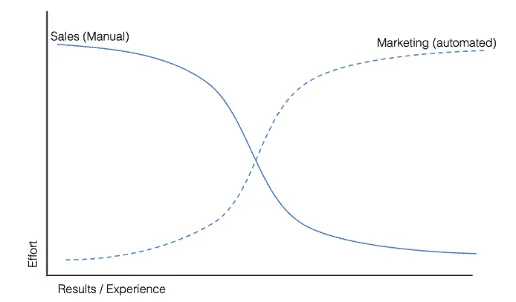
This is why we say the MSP marketing funnel is the sales process optimized and automated.
This means you must define your sales process first.
Selling is inherently manual, but as you optimize your sales process, you incorporate bits and pieces of automation to help you until you eventually build the complete marketing funnel.
As I mentioned above, marketing actually starts with product design and continues through sales and how you deliver your product. Once your process is working, you can automate it, but first, you have to get your process working.
So start by designing your MSP product around a specific customer.
Next, develop your prescriptive sales program
Then move on to your Dream 100.
The Dream 100 is a good way to address the cost of acquisition: you’ll still pay more than the next guy to get a certain client, but since you focus your spending on very specific prospects rather than on trying to attract random people, your total spend goes down.
See, prospects need to hear from you 6-8 times before they remember you (and up to 30 times before buying).
So imagine you send 1000 people a generic piece of mail with some aspirin in it. That will cost you at least $2000; you have touched 1000 people only once. If you have to do that 5 more times, that will cost you another $10,000 (for a total of $12,000); all you will have done is make them remember you. You will likely need to spend another $20,000 to $30,000 to get someone to buy.
If you spend $12,000 on the first 10 of your top 100, they will remember you. You will likely win a customer.
Fourth build your network with your 250×250 strategy. This comes from Tim Templeton’s Referral of a Lifetime, and it is a powerful networking strategy that will also bring you clients but this is a long-term strategy. So start with the Dream 100.
Also, be sure you get your messaging right.
The first problem with marketing is that you will likely get your messaging wrong.
You will talk about yourself and what you do rather than your clients and their needs.
That won’t work. In fact, there are three fundamental rules to messaging:
Nobody cares about you.
They only remember the problem you solve.
They won’t do the work (any work) to figure out the problem you solve.
(Download our guide to the three rules here).
Next, you need to make sure you are appealing to their reptilian brain, the listening part of their brain, rather than the neocortex or the thinking part. Here are six ways to create messaging that appeals to people.
Once your sales process is nailed down, you can start automating it with your MSP Marketing Funnel.
You start automating marketing by creating the journey through which they will get to know you. Here is an overview of the DNA-aware marketing journey.
I cover that as well in this video:
You can start building that journey with our MSP Digital Marketing Blueprint, which is a step-by-step walkthrough with templates for creating your first automated funnel.
So, Sales and marketing are a process; they are the same thing with different levels of automation, and the process itself is baked into our DNA.
Everybody complicates marketing. They tend to get stuck in the tactics, tools, and how of it.
Here’s a tip: keep the how simple at first. Keep it manual; let it be inefficient. Use the conversations and interactions you have to improve the process.
Start by understanding the why as I’ve laid it out here, build your what as I’ve laid it out, and optimize the how over time. You can’t optimize the how if your what isn’t defined and running swimmingly.
The bad news is that there aren’t any shortcuts, and focusing on tactics without a strategy is a sure path to high blood pressure and a low bank account.
The good news is that tactics without strategy are soaking up your resources. If you focus on the principle in this post, you’ll stop losing so much money and sell more. Which is what you want anyway, right?
FAQ
What is “Lead Generation,” or “Lead gen,” as the cool kids say
Lead generation is when a marketing prospect becomes someone you talk to about selling your services.
There are many mysterious practitioners with weird and wonderful ideas. Yesterday, someone on LinkedIn probably offered you yesterday10 leads for a fixed fee or no fee. BDR/SDRs promise to make calls and find leads. Content marketing, outreach, and cold calling are all lead-generation activities.
There is no mystery and no magic bullet. Lead generation is a process. If you don’t know what you are selling and to whom, you will waste all your lead generation spending. On the other hand, get clear about your business, and lead generation can be a set-it-and-forget-it activity.
What is a marketing funnel
Marketers often talk about the funnel. Some build entire businesses around marketing funnels. I wish I’d done that.
Here’s what they mean by that;
The phases of marketing, as I’ve laid out above, are:
Awareness
Engagement
Subscription
Conversion
Ah-ha
Ascension
Each stage has a conversion to the next that’s less than 100%; for example, the people who convert (or move) from awareness to Engagement might be 20%. So, 20% of the people who become aware move on to Engagement.
Each stage has a specific conversion percentage. So, it might look something like this
Awareness: 20% convert to Engagement, say 100 become aware, so 20 move to Engagement
Engagement: 80% convert to subscription, 16
Subscription: 70% convert to conversion, 8
Conversion: 50% have an ah-ha moment, 5.6
Ah-ha: 50% of those who have an ah-ha moment move to ascension, 2.8
When you plot this, it looks a bit like a funnel, hence the name.
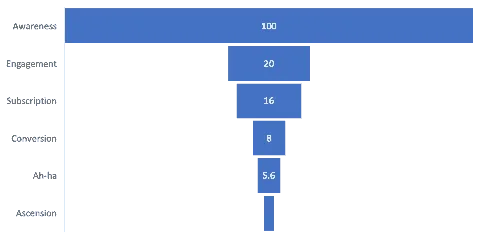
The funnel explains WHY paying for advertising to a generic website doesn’t work. You can have a ton of awareness, but if you don’t know the next step, your prospects won’t know the next step, either.
Get the MSP Digital Marketing Blueprint here.
Useful MSP marketing terms
B2B is business-to-business. If you are a business selling to businesses, you are in the B2B world. If you sell to consumers, then it is B2C. In truth, though, all marketing ends up being H2H, human-to-human.
Call to action: CTA is where you ask your prospects to take the next step.
Conversion: when a prospect becomes a customer. We separate this from ascension because we think it is helpful to have a simple conversion offer that may be less than your complete offer.
Content marketing: this is all marketing, really. Since the beginning of time, you’ve needed content if you want to sell or market anything. Today, it primarily refers to blogs, videos, or other content that attracts prospects.
Persona/Avatar: this is the personification of your target market. It’s a fictional stereotype of your buyer.
PPC: pay-per-click, generally a money pit unless you have a marketing strategy. With a marketing strategy, it is the cheapest way to attract new traffic.
Traffic: the people who become aware of you, generally those who visit your website.
SEO: search engine optimization. You put content online, Google finds it and delivers organic traffic through search. SEO takes time, but it is a great place to start. Create content and start seeing what sticks.
Organic traffic: traffic you don’t pay for. Organic traffic takes a lot of work and is often expensive.
What are some useful MSP marketing strategies?
Looking for some actions you can take now to start marketing your MSP? Check out these 5 simple, immediately implementable MSP Marketing Ideas.
Other Useful marketing strategies include:
Build a professional website that highlights your services and expertise.
Implement search engine optimization (SEO) techniques to improve your website’s visibility on search engines.
Utilize targeted content marketing through blog posts, case studies, and whitepapers to establish thought leadership in the industry.
Leverage social media platforms to engage with your target audience and share valuable content.
Develop partnerships and collaborations with complementary businesses to expand your reach.
Offer referral programs to incentivize happy clients to recommend your services.
Attend industry events and conferences to network with potential clients and stay updated on the latest trends.
Collect and showcase customer testimonials and positive reviews to build trust with potential clients.
Use email marketing campaigns to nurture leads and inform existing clients about your services.
Remember to analyze and track the performance of your marketing efforts to make data-driven decisions and optimize your strategies.
