

How to Scale Your MSP Without Burning Out: The “Shift Left” Strategy That Boosted One Owner’s Profit Margin to 86%
Here’s the uncomfortable truth about MSP scaling: if your managed services business can’t run without you answering every technical question, you don’t own a business — you own a job that pays worse than most.
George from BizTech Pro learned this the hard way.
He was drowning in Tier 3 support tickets, paying a six-figure salary to a Level 1 technician who basically sat around waiting for George to do the actual work, and — here’s the kicker — he had to stop taking new MSP clients because he couldn’t handle the workload.
Let that sink in. He turned away revenue because he was too busy being a highly paid technician instead of growing his managed services provider business.
If this sounds familiar, keep reading. George’s MSP turnaround story isn’t about working harder or hiring more people. It’s about one simple concept that most managed service providers completely miss: Shift Left.
Not only that, but George has taken these concepts and built a business around them. T3 Tech Partners is the Tier 3 support George and his partner Kris needed for themselves. They solve Tier 3 problems and document there bejesus out of them so you can shift left.
What “Shift Left” Means for MSP Operations
Forget the tech jargon for a second. Shifting Left in MSP support means pushing work down to the lowest level technician who can handle it — through documentation and standardized processes, not wishful thinking.
The ideal MSP support structure looks like this:
Tier 1 handles 70% of everything
Tier 2 gets 20%
Tier 3 deals with 10% (the weird stuff)
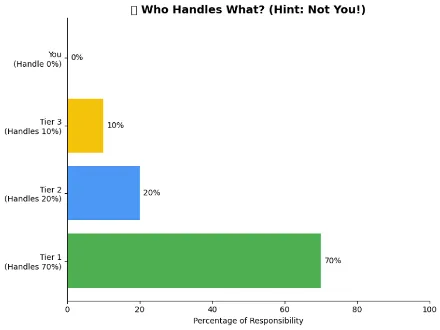
George started at the opposite end. He was handling most of the technical support work while paying someone else to watch him do it. Sound like an efficient MSP operation? It wasn’t.
What we’ve found, working with dozens of MSPs to scale their businesses, is that most MSPs fall into this trap. Here’s how to avoid it.
How MSP Owners Become Their Own Bottleneck (And Why It Kills)
George hit his limit when he realized he was essentially paying $100,000+ for a technician to be his apprentice. Every complex IT issue landed on his desk. Every managed services project became his project. Every client emergency became his emergency.
The result? No time to sell managed services. No time to lead his MSP team. No time to think about business growth beyond the next fire.
He actually paused new sales — turned away potential MSP clients — because he couldn’t handle more work. That’s not sustainable growth. That’s insanity wearing a business suit.
The MSP Documentation Strategy That Changes Everything
George’s solution wasn’t revolutionary. It was just relentless.
The rule: If someone asks a technical question twice, it becomes documented MSP knowledge.
He brought in Kris, a solid Tier 3 technician, not just to handle complex IT support but to help build what every managed service provider needs: a knowledge base that doesn’t live in the owner’s head.
Kris solved the problem and created the documentation. This worked so well that the concept is the backbone of T3 Tech Partners.
Here’s their MSP documentation process:
When a question arises, always check for an SOP, and make this mandatory.
If there is an SOP follow it. If it needs to be updated, then update it by following these next steps.
If there isn’t an SOP (or you need to update the one that exists), start creating one by recording what you do (or have someone else do it and record it, and then you review it). This works because writing technical documentation is hard, but talking through or demonstrating processes is easy. We like Loom and Scribe for this.
Edit to turn videos into proper MSP standard operating procedures (Loom and Scribe will help with this).
One question that comes up is “what if our technician won’t document?” If a technician won’t participate in the MSP documentation process, they have to go.
No negotiation.
No second chances.
Okay, maybe a second chance, you do have to set expectations. But if they can’t get with the program they can’t stay.
As George put it: “If you’re not participating in the MSP documentation process, you’re reaching into my pocket and stealing money.”
Harh? Maybe. Accurate? Absolutely.
The Results: How This MSP Achieved 86% Profit Margin
Within months, everything changed for George’s managed services business:
George’s stress dropped because he wasn’t the bottleneck for every technical decision. IT support resolution times improved because technicians had clear guidance. Client satisfaction went up because problems got solved faster.
But here’s the money shot: a modest 10% revenue increase led to 26% higher profit, pushing his MSP profit margin to 86%.
His Level 1 technician was now handling Level 3 support tasks. Not because they magically became smarter, but because the technical knowledge was documented and accessible.
“There may not be a Level 3 technician between me and my MSP team — but there’s a whole boatload of documents they can look at.”
That’s the difference between being indispensable and being strategic in your managed services business.
How to Implement Shift Left in Your MSP (Step-by-Step Guide)
Don’t try to document your entire managed services operation this weekend. Start small and build momentum:
Step 1: Audit your MSP support structure List everything you handle in a typical week. Be honest about what tier each task should be. If you’re doing it as the MSP owner, it’s probably too high-level.
Step 2: Ask the magic question for MSP efficiency For each task: “Could a Level 1 technician do this if they had clear instructions?”
If the answer is yes, that task needs to shift left in your MSP support process.
Step 3: Make MSP documentation automatic Use Loom, Snagit, whatever works for your team. Record yourself handling the technical work, then hand off the video to someone else to turn into a proper SOP.
Simple rule for MSP growth: If it happens twice, it gets documented. No exceptions.
Step 4: Reward the documentation behavior in your MSP Track documentation creation. Celebrate good SOPs. Make it part of your MSP culture, not just another task people ignore.
Scaling MSP Operations Beyond Technical Support
Here’s where most managed service providers stop thinking — but you shouldn’t.
Shift Left applies to every aspect of your MSP business:
Sales processes (document how you qualify potential managed services clients)
Billing procedures (create SOPs for MSP invoicing and collections)
Client onboarding (turn every managed services project into a repeatable checklist)
The goal isn’t just to get out of technical support work. It’s to get out of all the operational work that doesn’t require your specific expertise as the MSP owner.
The Bottom Line: Building a Scalable MSP Business
George didn’t scale his managed services business by working harder or hiring more technicians. He scaled it by building systems that worked without him.
The difference between a $300K MSP and a $1M+ managed service provider isn’t technical skill or market conditions. It’s whether the business can function when the owner isn’t there to answer every support question.
If you want to stop being your MSP’s biggest bottleneck, start shifting left. Document what you do. Train others to do it. Then step back and let them.
Your bank account (and your sanity) will thank you.
Ready to build MSP systems that scale? We help managed service providers implement the Shift Left strategy step by step — so you can stop being the answer to every technical question and start building a business that grows without you. Let’s talk.
Also, talk to George or Kris at T3 Tech Partners.
